

If you have business and are searching for a website developer in Nepal, you have probably already noticed the problem: hundreds of freelancers and agencies, wildly different prices, and no clear way to tell who actually delivers.
Quick answer:
In nepal most businesses should hire a local website developer or agency rather than an overseas freelancer, because local teams understand Nepali payment systems (eSewa, Khalti, Fonepay), respond faster in your time zone, and can meet in person when needed.
A basic business website costs NPR 15,000-60,000 in nepal while an e-commerce site or custom web application can run NPR 80,000 and up, depending on complexity.A freelancer is perfect for simple, projects in budget whereas an agency is the better fit when you need a team, ongoing support, or a more complex build.
This guide tells exactly what to expect: cost, timeline, platforms, red flags, and the questions you should ask before you sign anything.
Why Should You Hire a Professional Website Developer in Nepal?

Hiring a local website developer offers several benefits rather than working with an overseas freelancer or agency. Some of the reasons why working with a professional website developer in Nepal can benefit your business are mentioned below:
- Better understanding of the Nepali market: A local developer already knows how Nepali customers browse, what payment methods they trust, and what a Nepali business website needs to look credible, whereas an overseas freelancer has to be taught all of this from scratch.
- Faster communication: Same time zone means same-day replies instead of waiting overnight for a response from a different continent.
- Local support: If something breaks or you need an urgent update, a Nepal-based developer can respond immediately and, in some cases, meet in person.
- Payment gateway integration: This one matters more than most business owners expect. A developer unfamiliar with the Nepali market may not know how to properly integrate eSewa, Khalti, Fonepay, or ConnectIPS, and getting this wrong can mean lost sales on day one.
What Does a Website Developer in Nepal Actually Do?
The website developer covers a wide range of services, and not every developer specializes in the same type of project. Before hiring a website developer in Nepal, it’s important to understand which type of service best matches your business needs. The categories below will help you identify the right solution for your project.
- Business Website Development: Make a professional website that showcases your business, highlights your products or services, builds credibility, and makes it easy for potential customers to contact you.
- eCommerce Website Development: Develop a fully functional online store with products catalogues, shopping carts, payment gateway integration and seamless check out process.
- Custom Web Application Development: Develop tailored web solutions such as booking systems, customer portals, dashboards, learning management systems, CRM tools, or other applications designed to meet your unique business requirements.
- Landing Page Development: Design high-converting, single-page websites focused on a specific marketing campaign, product launch, or lead generation objective.
- Website Redesign Services: Refresh or completely rebuild an outdated website with a modern design, improved user experience, better performance, and mobile responsiveness.
- Website Maintenance & Support: Keep your website secure, up to date, and running smoothly through regular updates, security patches, performance monitoring, bug fixes, and ongoing content changes.
Most Nepali developers build using a mix of technologies depending on the project: WordPress for content-driven business sites, Laravel for custom backend systems, React and Next.js for fast, modern front-ends, and Shopify or WooCommerce for e-commerce.
There is no such things as universally best; the right choice entirely depends on your budget, timeline, and how much control you want over the code.
How Much Does Website Development Cost in Nepal?
Pricing varies more in Nepal than in most markets, because there’s no standard rate card; a freelancer and a full agency can quote wildly different numbers for the same brief. As a general guide:
| Website Type | Estimated Cost (NPR) | Typical Timeline |
|---|---|---|
| Landing Page | 8,000 – 20,000 | 3–7 days |
| Small Business Website (5–10 pages) | 15,000 – 45,000 | 1–2 weeks |
| Corporate Website (custom design, CMS) | 45,000 – 1,20,000 | 3–5 weeks |
| E-commerce Website | 80,000 – 3,00,000+ | 4–8 weeks |
| Custom Web Application | 1,50,000+ | 6–12+ weeks |
The cost of building a website depends on more than just its size. Here are some of the biggest factors that affect the final price:
- Custom design or template: A fully custom website usually costs more than one built using a pre-made theme because it requires more design and development work.
- Number of pages: A simple 5-page website will cost lesser compare to site with dozens of pages and more detailed content.
- eCommerce features: If you plan to sell products online, features like product management, payment gateway integration, shipping options, and order tracking will increase the development cost.
- Additional services: Content writing, professional photography, SEO, branding, and logo design can all be included in a project, but they typically add to the overall price.
- Maintenance and hosting: Some developers include website maintenance, updates, and hosting in their packages, while others charge for these services separately.
If you receive a quote that is much cheaper than others, don’t focus on the price alone. Ask what’s included. Low-cost quotes often leave out important services such as hosting setup, mobile optimization, basic SEO, security, or post-launch support. These extras may seem inexpensive at first but can end up costing more later.
Which Should You Choose: Freelancer vs. Website Development Company in Nepal
One of the biggest decisions you will make is whether to hire a freelance website developer or work with a website development company in Nepal. Both options have their advantages, but the right choice entirely depends on your budget, project requirements, and the level of support you expect after your website goes live.
The comparison below shows the key differences to help you decide which option is the best fit for your business.
| Factor | Freelancer | Agency |
|---|---|---|
| Cost | Lower upfront | Higher upfront |
| Experience | Varies widely, harder to verify | Vetted team, established process |
| Team | One person handles everything | Dedicated designers, developers, QA |
| Support | Depends on individual availability | Structured support channels |
| Scalability | Limited by one person’s bandwidth | Can scale with your business |
| Long-term Maintenance | Risk if they become unavailable | Built into the business model |
Choose a freelancer if you have a simple, well-defined project, a tight budget, and you’re comfortable with some risk if they get busy with other clients.
Choose an agency if you need e-commerce, ongoing SEO, a more complex build, or you simply want the reassurance that the project won’t stall if one person disappears.
What Features Should Every Modern Business Website Include?
No matter who builds your website, some features are essential if you want it to attract visitors, build trust, and help your business grow. A modern website should do more than look good; it should be fast, secure, easier to use, and must beoptimized for both search engines and your customers. Here are the key features every business website should include:
- Responsive Design: Your website must look and work perfectly on desktops, tablets, and smartphones, especially since most internet users in Nepal browse on mobile devices.
- Fast Loading Speed: A fast website improves user experience and decrease the chances of visitors leaving before your pages load.
- SEO-Friendly Structure: Clean URLs, proper heading tags, internal linking, and well-organized content help your website to grow because it lets search engines understand and rank your website more properly.
- SSL Security: An SSL certificate protects user data, displays the secure padlock icon in browsers which contributes to build trust with visitors and search engines.
- Content Management System (CMS): A CMS like WordPress allows you to update your website text, images, and blog posts without relying on a developer.
- Contact Forms: Make it easy for customers to get in touch by including simple, user-friendly contact forms.
- Google Maps Integration: If your business has a physical location, embedding Google Maps helps customers find you quickly and improves local visibility.
- Analytics Integration: Tools like Google Analytics let you track website traffic, visitor behavior, and conversions so you can make informed business decisions.
- Social Media Integration: Connect your website with your other social media profiles to increase engagement and make it easier for visitors to follow your brand.
- Blog Section: Regularly publishing helpful content can improve your search rankings, attract more organic traffic, and establish your business as an authority in your industry.
- Backup System: Automatic backups ensure your website can be restored quickly if there’s a security issue, accidental deletion, or server problem.
Which Platform Is Best for Website Development?

There is not a single best platform for website development. The right choice depends on what your business goals, budget, required features, and long-term plans is. For example, WordPress is an excellent choice for many business websites, while Shopify is designed for eCommerce stores, and Laravel or React are better suited for complex, custom-built solutions.
Understanding the pros and cons of each platform will help you choose the one that best fits your project.
| Platform | Best For | Pros | Cons |
|---|---|---|---|
| WordPress | Content-heavy business sites, blogs | Flexible, huge plugin ecosystem, easy to update | Needs regular maintenance/security updates |
| Shopify | E-commerce stores | Built-in payments, easy to manage, reliable | Monthly fees, less design flexibility |
| Laravel | Custom backend systems, business logic | Powerful, scalable, secure | Requires a developer for any changes |
| React | Interactive, app-like front-ends | Fast, modern user experience | Overkill for a simple brochure site |
| Custom Development | Fully bespoke requirements | No platform limitations, built exactly to spec | Higher cost, longer timeline |
How Long Does Website Development Take?
The time it takes to build a website depends on its size, features, and complexity. A simple business website can often be completed within a couple of weeks, while an eCommerce store or custom web application may take several weeks or even months. Most website development projects follow the same six stages:
- Discovery (1–3 Days): This is where the developer learns about your business, goals, target audience, and the features your website needs.
- Wireframing (2–5 Days): A basic layout is created to map out the structure of your website before any design work begins.
- Design (3–10 Days): During this stage, the visual appearance of your website is created, including colors, typography, images, and branding.
- Development (1–6 Weeks): The approved design is turned into a fully functional website with all required features and integrations.
- Testing (2–5 Days): Before launch, the website is tested across different devices and browsers to prevent any kinf of error. Forms, payment gateways, loading speed, and overall performance are checked to ensure everything works correctly.
- Launch (1–2 Days): Once everything has been reviewed and approved, the website is deployed to the live server, and final checks are completed.
As a general guideline, a standard business website usually takes 1-2 weeks, while an eCommerce website or custom-built solution typically requires 4-12 weeks, depending on the project’s complexity.
How to Choose the Best Website Developer in Nepal

Hiring the right website developer is more than finding the lowest price. A reliable developer should have the experience, technical skills, and support system needed to build a website that helps your business grow. Before making a decision, take time to evaluate the following:
- Review their portfolio: Look for real, live websites instead of screenshots. This gives you a better idea of the quality of their work.
- Check Google reviews: Genuine customer reviews can tell you a lot about communication, reliability, and overall client satisfaction.
- Read client testimonials: If they’ve worked with businesses similar to yours, that’s a good sign they understand your industry.
- Evaluate communication: A professional developer should respond clearly, answer your questions, and explain technical concepts in simple terms.
- Ask for transparent pricing: Make sure the quotation clearly outlines what’s included to avoid unexpected costs later.
- Look for SEO knowledge: Your website should be built while keeping search engines in mind from the beginning, not treated as an afterthought.
- Confirm mobile optimization: Since most internet users use their phones nowadays , a mobile-friendly website is essential.
- Discuss website speed: Ask how they’ll optimize images, caching, and performance to ensure fast loading times.
- Review security practices: Your website should include SSL, regular backups, and secure hosting.
- Ask about ongoing support: Find out what happens after launch and whether maintenance services are available.
What Questions Should You Ask Before Hiring a Website Developer?
Before signing any agreement, ask a few important questions to make sure you’re choosing the right developer for your project.
- What technologies do you use, and why are they suitable for my website?
- Will I be able to update the website myself after it’s launched?
- Is SEO included or not in the website development package or offered as a separate service?
- Who will own the website, source code, domain, and hosting after the project is complete?
- Do you provide website maintenance and support after launch?
- Can you integrate local payment gateways like eSewa, Khalti, or Fonepay if needed?
- What exactly is included in the quotation?
- How many revision rounds are included?
- What is your process if I need changes after the website goes live?
- Can you share references from previous clients?
Common Mistakes to Avoid Before Hiring a Website Developer
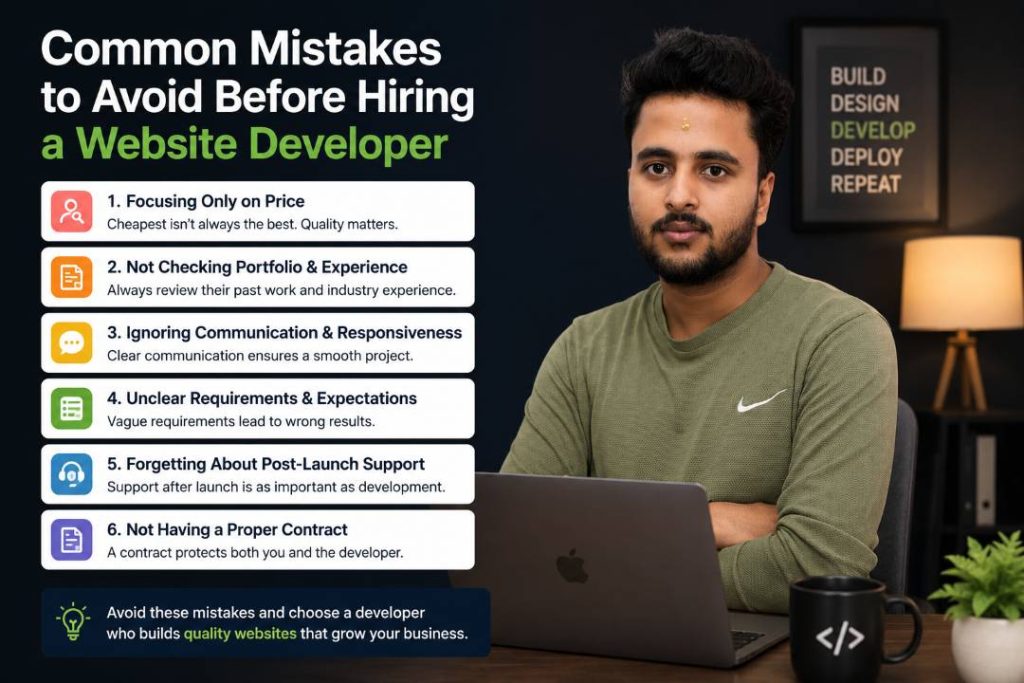
Choosing the wrong website developer can lead to delays, unexpected costs, and a website that doesn’t deliver results. Here are some common mistakes to avoid:
- Choosing based only on price: The cheapest option isn’t always the best. Low-cost quotes often exclude important services that you’ll end up paying for later.
- Not having a written agreement: Always ensure the project scope, timeline, pricing, and deliverables are clearly documented.
- Ignoring website maintenance: Every website requires updates, backups, and security monitoring after launch. Confirm how these will be handled.
- Overlooking SEO: A beautiful website won’t generate traffic if it isn’t built with SEO best practices.
- Ignoring website speed: Slow-loading websites frustrate visitors and can negatively affect search rankings.
- Skipping mobile testing: Your website should work flawlessly on smartphones as well as desktops.
- Not checking previous work: Always verify that the developer’s portfolio contains genuine, live websites.
Why Do Many Businesses Choose a Website Development Agency?
Many businesses prefer working with a website development agency because they get access to a complete team of professionals rather than relying on a single developer. Agencies typically have designers, developers, SEO specialists, and project managers working together to ensure every part of the website is planned, built, and tested properly.
A professional agency also provides support for long-term after your website goes live. Whether you need new features, security updates, SEO improvements, or technical assistance, you’ll have a dedicated team ready to help as your business grows.
Making the Right Choice for Your Business
Selecting the ideal web site developer is not simply about getting the least expensive option; rather, it involves investing in an option that will meet your requirements for many years. In this article, we have discussed all that you need to know including what website developers do, cost of website development in Nepal, differences between freelance developers and agency developers, platforms to use depending on the type of website and considerations for selecting the right one.
Consider your options carefully before choosing a developer by analyzing their experience, client portfolio, communication, technical expertise, and even post-launch support, among other things. Having a well-developed, safe, and search engine-friendly website can not only help boost your presence online but also create confidence among your users, increase opportunities for expansion, among others.
Looking for Affordable Website Development in Nepal?
Everything we have covered in this guide is available at Theme Nepal. Starting from business websites and eCommerce stores to custom web applications, we build fast, secure, and SEO-friendly websites at budget-friendly prices without compromising on quality.
Ready to bring your idea online? Contact Theme Nepal today for a free consultation and project estimate.
Frequently Asked Questions
Who is the best website developer in Nepal?
There isn’t a single website developer that’s the best for every business. The right choice depends on your project requirements, budget, and the level of support you need. Freelancers are often suitable for smaller projects, while agencies like Theme Nepal are a better choice for businesses looking for long-term support, eCommerce solutions, or custom website development.
How much does it cost to build a website in Nepal?
The cost varies depending on the type of website. A basic business website typically costs between NPR 15,000 and NPR 45,000, while eCommerce websites and custom web applications usually start from NPR 80,000 and increase based on the required features.
How long does it take to build a website?
A standard business website generally takes 1–2 weeks to complete. More advanced websites, such as eCommerce stores or custom web applications, usually take 4–12 weeks, depending on the project scope.
Should I hire a freelancer or a website development company?
If your project is small and your budget is limited, a freelancer may be a suitable option. However, if you need a professional business website, ongoing support, or a more complex solution, working with a website development company is often the better long-term investment.
Which platform is best for business websites?
There isn’t one platform that’s best for every business. WordPress works well for most business websites, Shopify is ideal for online stores, and Laravel or custom development are better suited for projects that require advanced functionality.
Can a website developer also help with SEO?
Yes, a professional website developer should build your website using SEO best practices, including clean code, fast loading speeds, mobile responsiveness, and a search-engine-friendly structure.