

Right now, thousands of people in Nepal are asking a question online, and your business doesn’t show up in the answer.
Maybe someone typed “best web design company in Kathmandu” into Google. Maybe someone asked ChatGPT, “Which trekking agency in Pokhara is trustworthy?” Maybe a customer in Australia asked Google AI Overview, “Who are good IT outsourcing companies in Nepal?” In every one of these moments, an answer was given, and it either included your business or it didn’t.
This is the exact problem this blog will fix.
For years, businesses in Nepal only worried about one thing: SEO (Search Engine Optimization), or getting to the top of Google’s search results. But search has quietly split into three different systems now: SEO, AEO (Answer Engine Optimization), and GEO (Generative Engine Optimization). If you only understand one of these, you’re invisible in the other two, and you won’t even know it’s happening because your website traffic numbers won’t tell you.
So in this guide, we’ll break down SEO vs AEO vs GEO in the simplest way possible, no confusing tech terms, no marketing terminologies. Just what these three things actually mean, why seo vs AEO vs GEO Nepal businesses can’t ignore this anymore, and exactly how to get found by ChatGPT and Google AI. By the end, you’ll know precisely what to do next.
What Are the Terms SEO, AEO, and GEO?
Let’s start simple. Think of the internet as one giant library, and search engines as the librarians who help people find the right book.
- SEO is just like organizing your book orderly on the shelf so the librarian can find it easily.
- AEO is just like (abstract) writing a short, clear summary on the back cover so the librarian can quote it directly to someone in a hurry.
- GEO is like being the author the librarian trusts so much, they recommend your book by name even before the person asks.
That’s really the whole difference between seo aeo and GEO in one picture. Now let’s look at each one properly.
What is SEO?
SEO stands for Search Engine Optimization. It’s the classic, well-known way of getting your website to show up when someone searches on Google. It includes things like:
- Using the right words on your page (keywords)
- Making your website fast and mobile-friendly
- Getting other trusted websites to link to you
- Writing helpful, well-organized content
SEO has been around for over 20 years, and it’s still the foundation everything else is built on. Without SEO, an AI engine can’t even find your page in the first place.
What is AEO (Answer Engine Optimization)?
Here’s what is AEO in SEO terms: it’s the practice of structuring your content so a search engine can pull out a short, direct answer and show it right at the top, without the person even clicking your website.
You’ve probably seen this already:
- The little answer box at the top of Google
- “People Also Ask” dropdowns
- Voice assistants like Siri or Google Assistant reading out an answer
That’s AEO in action. It’s not about ranking no.1 anymore, it’s about being the answer itself.
What is GEO (Generative Engine Optimization)?
Now for what is generative engine optimization. This is the newest and most important shift. GEO is about getting AI tools like ChatGPT, Google Gemini, and Perplexity to actually mention your business by name when they generate a full answer to someone’s question.
Here’s the key part: an AI doesn’t “search” the way Google does. It reads a huge amount of information and then writes its own answer, picking which sources or businesses to trust and quote. GEO is now becoming one of those trusted sources.

SEO vs AEO vs GEO in Nepal: The Real Difference
Let’s put it side by side so it’s crystal clear:
| SEO | AEO | GEO | |
|---|---|---|---|
| Goal | Rank high on Google | Get pulled into a direct answer | Get mentioned by name in AI answers |
| Where you win | Google search results | Featured snippets, voice search | ChatGPT, Gemini, Perplexity, AI Overview |
| What matters most | Keywords, links, speed | Clear, short answers | Trust, consistency, real data |
| Nepal example | Ranking for “web design Kathmandu“ | Answering “how much does a website cost in Nepal” directly | ChatGPT recommends your business when asked, “best hosting company in Nepal” |
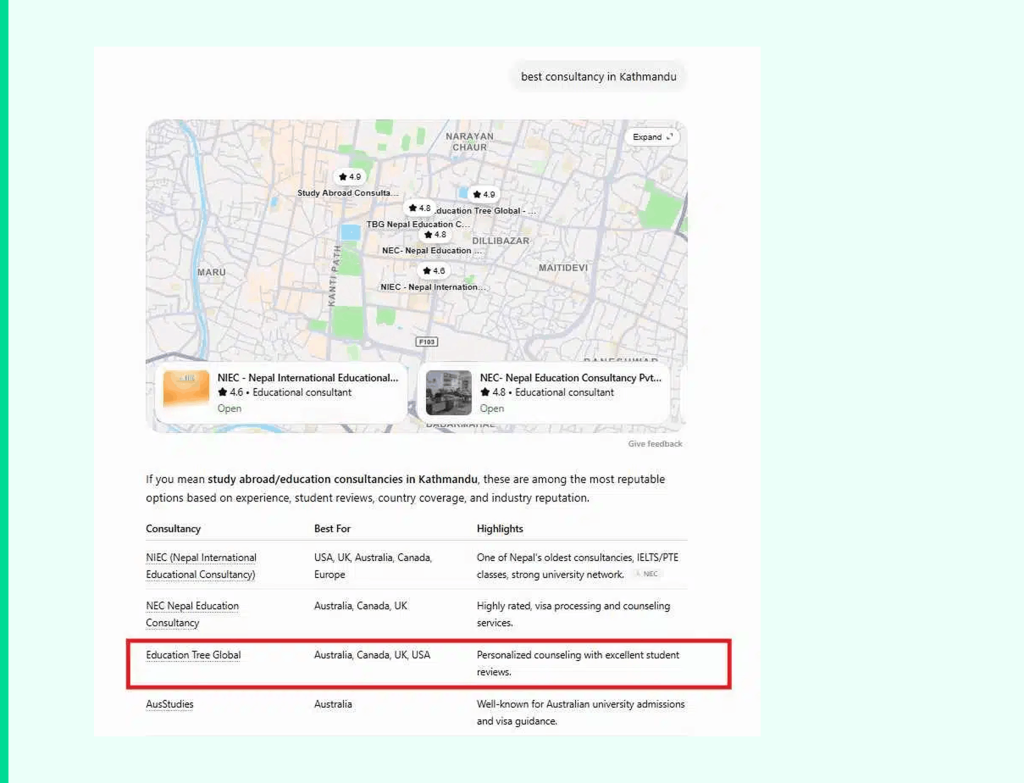
This is exactly why understanding SEO vs AEO vs GEO Nepal businesses face is so important right now. Here’s a simple truth people often miss: AI visibility vs. Google ranking are two completely different scoreboards. You can rank #1 on Google and still be completely invisible inside ChatGPT’s answer. And when it comes to local seo vs AI search in Nepal, local search is still mostly Google-driven, but AI search is growing fast, especially among younger, mobile-first users. As our client is already ranking in GEO. Below is the real evidence of Education Tree Global Consultancy.
Why Nepali Businesses Need AEO and GEO Now
Here’s why this isn’t something you can put off until “later”:
- Most Nepali websites still don’t do any of this. That means the bar to stand out is very low right now, a huge, real opportunity for AEO and GEO for Nepali businesses willing to act early.
- Mobile users in Nepal are searching differently. More people are asking questions in full sentences, out loud, or inside chat apps, not just typing two or three keywords.
- International customers are asking AI, not Google. A traveler planning a trek or a company looking for IT outsourcing in Nepal is increasingly likely to just ask ChatGPT directly rather than browsing 10 websites.
- Zero-click search is rising. Many people now get their answer directly from the search page or an AI chat, without ever clicking through to a website.
Our Clients Ranking in AEO, GEO & Local SEO
These aren’t just theories; our own clients (Education Tree Global Consultancy) and others are already showing up in real AEO, GEO, and Local SEO results across Google and AI tools like ChatGPT. Here’s a look at how real Nepali businesses we’ve worked with are getting found, answered, and recommended by name.
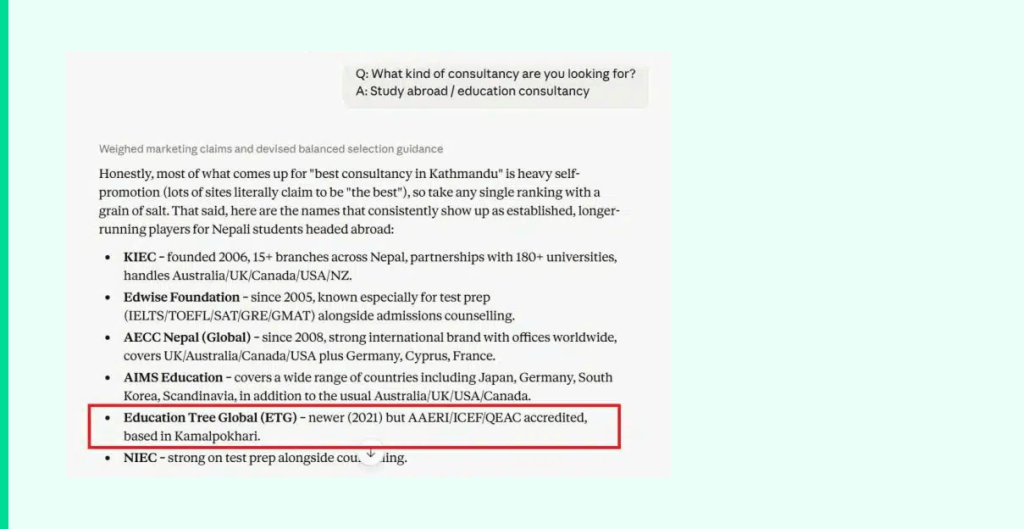
Getting real AI search optimization Nepal businesses need isn’t complicated, but it does require doing things differently than plain old SEO. And if you want to get cited by ChatGPT Nepal style, you need to be the business that gives clear, honest, and specific information, not vague marketing lines.
How to Get Found by ChatGPT and Google AI in Nepal
This is the part you actually came for. Here’s exactly how to get found by ChatGPT and Google AI, step by step.
Fix Your Google Business Profile First
Before anything fancy, this is step one. Your Google AI overview Nepal business listing needs to be 100% complete and accurate:
- Correct business name, address, and phone number
- Accurate opening hours (and keep them updated!)
- Only real photos, not stock or AI images
- Needed all genuine customer reviews
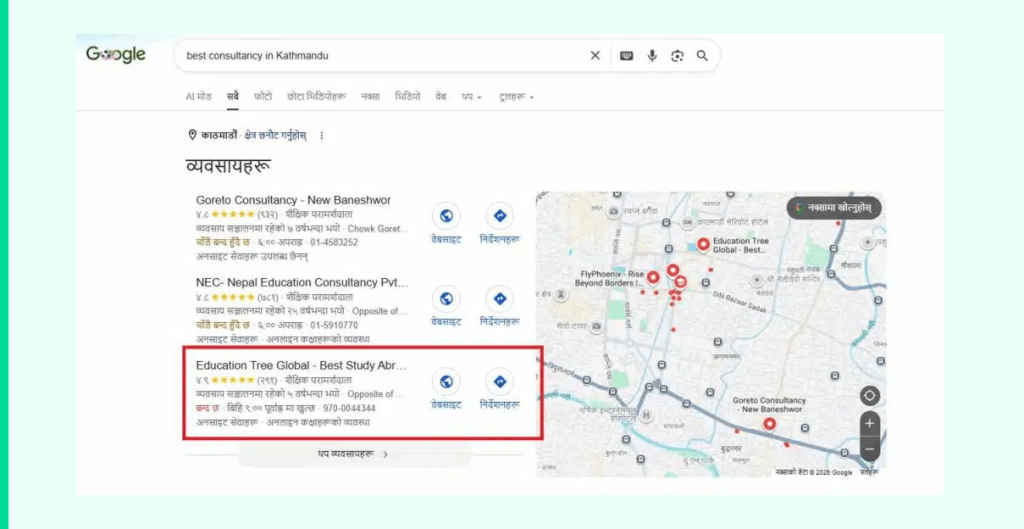
Why does this matter so much? Because AI tools check if your information matches everywhere online. If your phone number is different on Facebook than on your website, the AI gets confused and simply leaves you out rather than risk giving wrong information.
Answer Questions Directly on Your Website
This is the heart of how to rank in Google AI Overview Nepal results. Instead of writing long, wordy paragraphs, do this:
- Turn your headings into real questions (e.g., “How much does a logo design cost in Nepal?”)
- Answer the question in the very next sentence, in plain and simple words
- Keep that first answer short, around 40 to 60 words is perfect
- Save the longer explanation for after the short answer
This one habit alone can help you show up in Google’s answer box and inside AI chat replies.
Try the LLMs.txt File
Here’s a newer, slightly technical trick: the llms.txt file for your website is a simple text file you can add to your website that gives AI tools a clean, organized summary of what your site is about. Think of it as a cheat sheet just for AI. Most Nepali websites don’t have one yet, which means adding one puts you ahead of almost everyone.
You can also add schema markup for local business Nepal websites. This is a small piece of code that clearly labels your business name, address, services, and FAQs so both Google and AI tools can read your page correctly without guessing.
Build Real Trust Signals (E-E-A-T)
AI tools (and Google) look for four things before trusting a website: real Experience, Expertise, Authoritativeness, and Trustworthiness, often shortened to E-E-A-T. In simple terms:
- Show real experience: mention how long you have been doing this, share real examples or real facts and case studies
- Show expertise: write with actual knowledge, not copied filler content
- Build authority: get mentioned or linked by other respected Nepali websites
- Earn trust: keep your facts accurate, consistent, and updated regularly to gain genuine trust.
This is genuinely the most important long term habits for both the AEO and GEO , not shortcuts, just honest, well-documented expertise.
AEO and GEO for Different Nepalese Industries
Different types of businesses in Nepal should focus their energy differently. Here’s how:
Trekking & Travel Companies
AEO for trekking and travel companies in Nepal should be the first priority. International tourists often ask AI tools things like “is Everest Base Camp trek safe” or “best trekking company in Pokhara” before they ever visit a website. Answering these exact questions clearly on your site puts you directly in that conversation.
IT Outsourcing Organizations
The focus shifts to GEO for IT outsourcing companies in Nepal. When looking for a development partner in Nepal, foreign clients are increasingly using ChatGPT or Perplexity rather than Google. This means that in this scenario, developing real authority, customer case studies, validated reviews, and unambiguous service pages are more important than keyword techniques..
E-commerce Companies
Clear product descriptions, precise specs, and sincere customer reviews should be the main focus of AI search optimization for Nepali e-commerce businesses. AI systems are much more interested in precise information (size, cost, materials, delivery time) than in general terms like “best quality guaranteed.”
Small Local Companies
Lastly, AI search optimization for Nepalese small business owners is frequently the most straightforward: a comprehensive Google Business Profile, an understandable FAQ area on the website, and consistent business information across the internet. In fact, tiny firms have an edge here since it’s simpler to be honest and specific when you’re small.
Ready to Get Found on Google, ChatGPT & AI Search?
Ranking on Google alone is no longer enough. At ThemeNepal, we help businesses optimize for SEO, AEO, and GEO – so your brand appears in Google Search, AI Overviews, ChatGPT, Gemini, and other AI-powered search platforms.

Conclusion
The shift from SEO to SEO vs. AEO vs. GEO isn’t something that’s happening far in the future. It is already happening in Nepal right now: every time someone asks ChatGPT or Google AI Overview a question instead of typing it into a search bar. The good news? Most Nepali businesses haven’t started yet. That means showing up first with honest, clearly structured information gives you a real head start.
Begin by updating your Google Business Profile, responding to actual inquiries on your website, and maintaining consistent information across all platforms. You won’t merely rank if you do that regularly; you’ll be the solution.
Frequently Asked Questions
1. What is the main difference between SEO, AEO, and GEO?
SEO basically helps you to rank on Google search results. AEO helps your content get pulled out as a direct answer, like a snippet or voice reply. GEO helps AI tools like ChatGPT and Gemini choose to mention your business by name when generating an answer. All three work together, not against each other.
2. Does my business need AEO and GEO?
Yes, if you want to stay visible as more people use ChatGPT, Gemini, and Google AI Overview to make decisions. Even a small Nepali business can benefit, since these tools are increasingly used for daily questions like “best restaurant near me” or “reliable web hosting company.”
3. How do I know if ChatGPT mentions my business?
The simplest way is to manually ask ChatGPT, Gemini, or Perplexity your own business name and your main service category (like “best web design company in Kathmandu”) every few weeks, and see if you’re mentioned. There are also paid AI-visibility tracking tools, though most are built for larger international companies right now.
4. Is Google Business Profile important for AI search?
Extremely important. Google Business Profile is one of the main sources AI tools check for accurate business information. A complete, accurate, and consistent profile is one of the easiest and most effective things you can do today.
5. Is it possible for a small company to compete for AI visibility?
Indeed, it’s actually easier than you may imagine. AI systems prioritize precise, truthful, and consistent data over large marketing expenditures. A much larger competition with extensive or conflicting information may not be referenced as frequently as a small business with clear facts and genuine evaluations.